



A Review of “Insurance. The Great Enabler” by the Howden Group jointly with the Boston Consultancy Group and the UN Climate Change High Level Champions, 2024.
By Reimund Schwarze and Peter B. Meyer
The Howden Group, Europe’s largest specialty insurance broker, has argued that insurance may serve a critical role in de-risking investments and providing financial security to enable the global economy to transition to net zero while building resilience to climate impacts. Traditionally, businesses have approached insurance as a short-term operational necessity, often relegating it to procurement discussions rather than integrating it into strategic planning. However, the scale of the climate challenge and the associated risks demand a fundamental shift in this mindset. By 2030, the climate transition will necessitate $19 trillion in investment globally, requiring insurance coverage for up to $10 trillion of these funds (Howden, BCG & HLC, 2024, p.5). Simultaneously, premiums for physical risks and natural catastrophes are expected to increase by another 50%, reaching $200–250 billion annually due to rising climate-related losses, growth in claim exposures, climate risk disclosures, and the privatization of public liabilities. (Howden & BCG, 2024, p. 6)
To meet this unprecedented demand, they argue, businesses and insurers must forge long-term partnerships, emphasizing collaboration, cross-sector planning, and strategic alignment. Insurers must develop bespoke coverage options, provide risk consulting, and play a central role in reducing project risk and thus the cost of capital. Businesses, in turn, must engage insurers early in their climate transition plans to ensure bankability, insurability, and resilience. These are the key messages of a new study on insurance solutions to enable 10 trillion US dollars in private finance to be invested in addressing climate change issues, which was presented at a prominent side event of the 29th Conference of the Parties (COP29) in Baku with the dedicated support of the High-level champions from the COP28 and COP29 presidencies, HE Razan Al Mubarak und Nigar Arpadaral (Howden, BCG and HLC, 2024, p.3).
What is an Enabling Insurance Solution?
The Howden study opens with a review of the history of insurance as an enabler of change. It then turns to the accelerating capacity constraints on the industry that are undermining its ability to fulfill this role today.
Insurance has enabled transformative economic advances over time by managing risk, setting standards, and fostering collaboration. For instance, maritime insurance facilitated the rise of global trade, fire insurance led to improved urban building safety standards, and insurance paved the way for the adoption of both steam power and electrification, and thus modern industry. Similarly, the insurance industry today can drive progress in the climate transition by providing the foundational security needed to unlock trillions of dollars in investment. However, fulfilling this role requires insurers to expand their capacity and develop innovative solutions to address the risks posed by new technologies, industrial processes, and climate impacts.
New technologies and industrial processes are integral to the climate transition but often introduce risks and uncertainties that can make insurance unaffordable or unavailable. For example, wind power projects in Pakistan’s Indus River Delta are highly vulnerable to tidal erosion and storm surges in the face of climate change, which will increase maintenance costs and disrupt energy production, undermining the long-term financial viability of these projects. Asset protection insurance could stimulate investment in mangrove forest restoration along the river to provide a natural barrier to protect wind power infrastructure through a hybrid insurance solution (Howden, BCG, and HLC, 2024, p. 6). This approach, however, requires early collaboration between businesses and insurers to align insurance products with the risk profiles of new projects. Insurers can enhance bankability by providing tailored coverage and risk- informed guidance during the design and construction phases. Moreover, insurers’ expertise in risk analytics can help businesses make informed decisions and reduce uncertainties. Businesses have long assumed that insurance capacity would remain readily available when needed. However, this assumption no longer holds in the face of the climate crisis. The global demand for insurance is expected to outpace supply by 2030, driven by $19 trillion in committed investments across energy, transport, and buildings.
The frequency and severity of natural catastrophes have increased dramatically in recent years. Over the last decade, there has been an average of 190 catastrophic events annually, compared to 160 in the preceding decade. This, Howland notes, has resulted in over $2 trillion in economic losses in the past decade, with insurers covering less than half. In the past five years, average annual insured losses from natural catastrophes have exceeded $100 billion, driven by both extreme events and more frequent medium- to low-impact incidents like storms and floods. As climate impacts intensify, demand for insurance protection against physical risks will continue to grow. The study identified three key factors as drivers of this demand:
🔹Growth in Exposures: Urbanization and population growth in high-risk areas are increasing vulnerabilities.
🔹Climate Risk Disclosure: Regulatory requirements for transparency and risk management are resetting expectations for insurance coverage.
🔹Risk Privatization: Governments are shifting the financial burden of climate risk to private markets, often through mandatory insurance requirements.
Concerned with keeping premiums affordable in the face of the emerging insurance gap, Howland notes that insurers must improve risk assessment tools, promote investment in resilience, and work with governments on risk-sharing mechanisms. The authors observe that public-private partnerships can incentivize these initiatives, but poorly designed collaborations can lead to market disruption. They offer an insurance transformation program for the climate challenge.
Case studies of enabling insurance solutions
The study includes eleven case studies showing the range of existing insurance solutions to accelerate the transition (see Table 1). The case studies aim to show that the insurance industry can accelerate the transition through de-risking, while mobilizing finance at speed and scale, driving the scale-up of nature-based solutions and supporting new forms of investment that in sum would power $10 trillion of climate finance (Howden, BCG and HLC 2024).
🔹 To unlock the private funds pledged at the 2021 UN Climate Conference in Glasgow, it is crucial to de-risk the climate transition and support resilience efforts. At COP26, over 5,200 businesses committed to net-zero carbon targets by 2050, and around 450 financial institutions—representing 40% of the world’s private capital—pledged to make their portfolios climate neutral (Kassia and Victor, 2022). However, the associated risks pose unique financing challenges. Insurers should lead the de-risking conversation within the financial community to ensure insurance is optimally utilized to reduce the cost of capital.
🔹 Experience shows that once a project becomes operational, it may not meet expectations or its environmental impact may be less significant than anticipated. Consequently, available funds often remain unused as projects frequently exceed the risk tolerance of investors and creditors, making operational and performance improvement crucial to overcoming this challenge.
🔹 However, capacity and affordability will ultimately drive the speed of private capital reallocation for risk and vulnerability reduction. Public policy support for risk-sharing mechanisms will therefore be crucial for scaling up nature-based solutions and supporting new forms of investment.
Table 1: Case studies of enabling insurance solutions
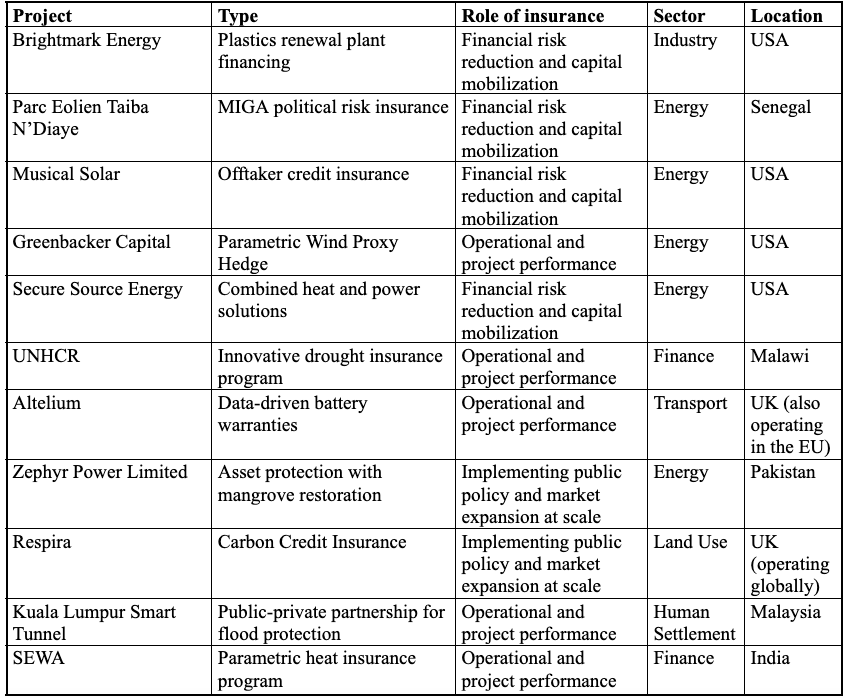
Source: Adapted from Howden, BCG, and HLC (2024).
The study concludes that the insurance industry has a unique role to play in enabling climate change response by mitigating risk, unlocking capital, and promoting resilience. However, addressing the structural pressures on insurance systems will require unprecedented collaboration between companies, insurers, and governments. Hence, it proposes a new business model for insurance.
Enabling Insurance Solutions for Climate Challenge as a new business model
According to the authors, companies and insurers need to rethink their traditional insurance approaches to overcome the unique challenges of the climate crisis. Their most important recommendations include
For Businesses:
🔹 Elevate Insurance to a Strategic Priority: Recognize insurance as a cornerstone of climate transition and resilience planning.
🔹 Engage Insurers Early: Collaborate with insurers during new business planning stages to enhance bankability and mitigate risks.
🔹 Assess Physical Risks: Use insurance insights to make informed decisions about investments and resilience measures
For Insurers:
🔹 Expand Capacity and Innovate Products: Ensure adequate coverage is available to meet the evolving needs of businesses.
🔹 Provide Risk Consulting and Analytics: Help businesses understand and integrate climate risks into their strategies.
🔹 De-Risk Investments: Collaborate with financial stakeholders to enhance the insurability and bankability of climate projects.
The way forward, the study proposes, is a new model that they call “radical collaboration”. To respond effectively to climate change, according to the authors, businesses and insurers must adopt long-term thinking, moving away from short-term procurement cycles. This shift requires building multi-year partnerships and integrating insurance into strategic decision-making. By doing so, businesses could secure the resources they need to thrive while advancing the global transition to a resilient, net-zero economy.
A critique of the Howden initiative
The concept of “The Great Enabler” by Howden, BCG, and the High Level Champions emerges at a critical juncture in the COP negotiations, where climate finance is increasingly recognized as a cornerstone for achieving the twin goals of Net Zero Emissions and Climate Resilience outlined in the Paris Agreement. Satisfying the political and scientific imperative for “moving from billions to trillions” in climate finance has become a defining ambition for the future COPs. At COP29 in Baku, a commitment was made to realize this goal within one year, culminating in COP30 in Belém, Brazil. However, the clock is ticking, and progress on this pledge remains insufficient. Against this backdrop, a $10 trillion initiative by globally leading insurers arrives at an opportune moment to address the impasse encountered at COP29. Yet, radical collaboration must not be mistaken as constituting radical transformation. In our view, this proposal falls short of what is truly required to prepare and transform the insurance sector for Net Zero and climate resilience. Several critical points must be raised regarding the Howden initiative:
🔹 The insurance crisis is far deeper than the need for new business models and regulatory adjustments. While heightened awareness of risks has fueled demand for risk management tools, the growing prevalence of uninsurability in countries across the globe poses a fundamental threat, not only to the global economy’s transition to Net Zero but to global economic development itself, which we often take for granted. Climate change itself is the driver of growing uninsurability as it creates ever more uncertainty about the path it takes and the impacts it generates on weather conditions and associated damages. When uncertainty becomes so great that it undermines the ability to determine risk, it renders insurance impossible.
🔹 The initiative focuses exclusively on risk mitigation for climate-related and, to some extent, nature-based solutions, while ignoring the urgent need to stop insuring fossil fuel projects. According to a 2023 report by Ceres, ERM, and Persefoni, the 16 largest US insurers alone have more than 50% of their assets, amounting to half a trillion dollars, invested in fossil fuels. However, advocating for Net Zero and climate resilience while committing significant assets to fossil fuel infrastructure development would not only be a strategic shortfall, but blatantly hypocritical. Such a failure undermines the potential of the Howden Initiative to bring about necessary and meaningful change.
🔹 The Howden Initiative originates from the current need for climate finance under the United Nations Framework Convention on Climate Change (UNFCCC), but makes little or no reference to previous United Nations financial sector initiatives. The United Nations Environmental Program’s Finance Initiative (UNEP FI) is a global initiative of the United Nations with 430 leading financial institutions, including currently 172 leading insurers, that has been working for many years to integrate sustainability considerations into financial practices. Launched at the 2012 UN Conference on Sustainable Development, the UNEP FI and its member organizations agreed on the Principles for Sustainable Insurance (PSI) to serve as a global framework for the insurance industry to address environmental, social, and governance (ESG) risks and opportunities. They have meanwhile become part of the insurance industry criteria of the Dow Jones Sustainability Indices and FTSE4Good. The Net-Zero Insurance Alliance (NZIA) is another UN-backed initiative created in July 2021 to help the insurance industry transition to a low-carbon economy, convened by UNEP’s Principles for Sustainable Insurance (PSI). Following the demise of the NZIA after the departure of several high-level US insurers in 2023, the UN-Forum continues to develop insurance policies and practices in close cooperation with stakeholders aimed at accelerating a just transition to a resilient net-zero economy. The Howden Initiative ignores these and other UN-backed initiatives, tacitly supporting the anti-ESG movement that led to the NZIA downfall two years ago.
🔹 The initiative is overly focused on mitigation sectors such as industry, energy, and transport, offering only limited examples of adaptation and disaster risk reduction (DRR) investments. This imbalance leaves the ‘adaptation gap’ (UNEP, 2024) between actual adaptation efforts and societal goals unresolved. Additionally, the proposal does not address the growing need for funds to cover loss and damage from climate change. To the extent that those losses are covered by insurance, and massive claims have already been filed and paid out, adaptation failures can further weaken insurance reserves and make any form of coverage harder to obtain. In short, while the Howden initiative may suggest a step in the right direction, it lacks the depth and breadth necessary to address the systemic challenges confronting the insurance industry and its critical role in supporting the Net Zero transition and climate resilience. It just offers a false hope, not a real path forward.
Literature
🔹 Ceres, ERM and Persefoni (2023): New Research Shows Insurance Sector has Significant Exposure to Fossil Fuel Assets Despite Vulnerability to Climate Change | Ceres: Sustainability is the bottom line (accessed 2.1.2025).
🔹 Howden, Boston Consulting Group (BCG) and UN Climate Change High Level Champions (HLC) (2024). The Great Enabler. A collection of insurance solutions powering $ 10 trillion of climate finance. https://www.howdengroup.com/uk-en/news-insights/the-great-enabler (accessed 2.1.2025).
🔹 Howden &BCG (2024) The bigger picture. The $10 trillion role of insurance in mobilising the climate transition. the-bigger-picture-whitepaper.pdf (accessed 2.1.2025).
UNEP (2024): The Adaptation Gap Report 2024: Come hell and high water. https://www.unep.org/resources/adaptation-gap-report-2024 (accessed 3.2..2025).
🔹 Kassia Yanosek and David G. Victor (2022). How Big Business Is Taking the Lead on Climate Change. Harnessing Private Capital for the Public Good. Foreign Affairs. https://www.foreignaffairs.com/articles/world/2022-02-03/how-big-business-taking-lead-climate-change (accessed 3.2..2025).