



Building a Common Framework for Shared Resilience
Introduction
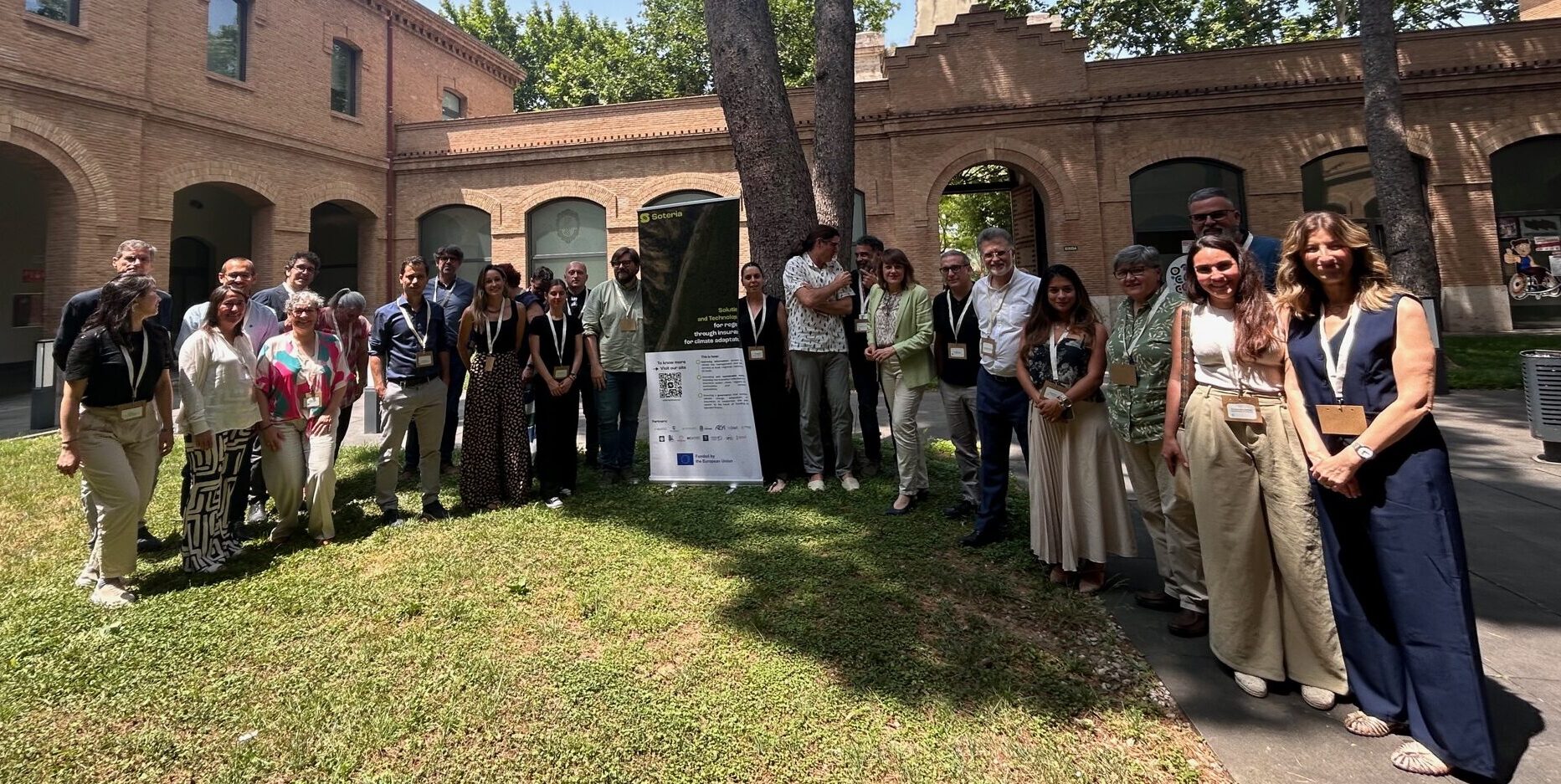
On June 5th, 2025, a total of 52 stakeholders (60% women and 40% men), gathered at the Regional Ministry for the Environment, Infrastructure, and Territory in Valencia, Spain, to participate in a Climate Resilience Dialogue (CRD), and discuss the SOTERIA’s Valencian pilot case study: the Marjal dels Moros wetland.
This CRD emerged from a series of sectoral workshops held throughout 2024 with key stakeholders linked to the Marjal dels Moros—such as representatives from agriculture, industry, local government, and NGOs. These workshops, facilitated by the Regional Ministry for the Environment of the Valencian Community under the SOTERIA project, aimed to explore sector-specific perspectives on the wetland in the context of climate change. A shared priority quickly emerged: the conservation and restoration of the Marjal as a strategic asset for building climate resilience.
Marjal dels Moros is a wetland located 30 km north of the city of Valencia, between the municipalities of Sagunt and Puçol. It covers an area of 620 hectares and is protected under several conservation designations, including its recognition as a Protected Wetland and its integration into the Natura 2000 Network as a Site of Community Importance (SCI) and a Special Protection Area for Birds (SPA). In 2015, it was also declared a Special Area of Conservation (SAC). Its protection not only helps mitigate climate risks but also plays a key role in managing the challenges associated with the energy transition.
Objectives
The main objective of the CRD was to co-develop a shared resilience framework. During the workshop, participants prioritized a set of resilience indicators selected from the EU Taxonomy and Spain’s National Adaptation Plan. These indicators serve as the foundation of a practical, measurable framework that integrates sectoral contributions and aligns with local, national, and European adaptation strategies.
Shared resilience framework
This shared resilience framework will be directly linked to the ongoing update of the 2018 Marjal dels Moros Management Plan (Plan Director), which is currently being revised. The prioritized indicators from the CRD will guide the development of restoration and conservation activities within the updated Plan, helping to establish clear priorities and measurable outcomes. The goal is for the Plan to become a strategic tool capable of attracting diversified funding—including private sector contributions—while strengthening public-private collaboration and enhancing climate resilience at the local level.
Additionally, the Insurance Compensation Consortium (Consorcio de Compensación de Seguros, CCS) presented the critical role of the insurance sector in climate adaptation, emphasizing its function in responding to extreme weather events and the advantages of Spain’s solidarity-based insurance system. Finally, the CCS highlighted the value of loss data it manages as a resource to support evidence-based decision-making and more effective climate planning.
Key take-aways
- – Climate adaptation is an urgent and high priority in the Valencian Region, given its high vulnerability to climate change impacts. International, European, national and regional frameworks are aligned to enable a coordinated response.
- – Coastal wetlands such as the Marjal dels Moros are recognised as effective nature-based solutions to reduce risks and protect the environment, the economy and public health.
- – Climate adaptation is not only necessary but also cost-effective. The PVIECC 2030 will be the main tool to coordinate regional action, while the involvement of municipalities, supported by dedicated funding, is essential to advance climate resilience.
- – The CCS provides coverage for extreme events, facilitating recovery and providing valuable data for risk planning. The Spanish insurance system, with mandatory coverage for extraordinary events, maximises mutualisation, maintains affordable rates and centralises damage data, supporting risk management and climate adaptation.
- – The increase in extreme weather events threatens the financial sustainability of the insurance system, making complementary strategies essential. Ecosystem restoration, such as the restoration of wetlands, offers a cost-effective and sustainable way to reduce long- term climate risks. Coastal wetlands like the Marjal dels Moros are crucial natural infrastructures.
- – The Marjal dels Moros Master Plan (2018) is a living document currently being updated and revised. The original plan established a comprehensive vision for restoration, with 36 actions across nine areas and an investment of over €8 million. The update proposes a model of adaptive governance and innovative financing to integrate participatory investment among stakeholders. The updated plan will consider the indicators prioritized in the workshop.
- – Adaptation must be locally grounded and participatory, involving regional stakeholders and aligning indicators with national and local priorities. The active participation of local stakeholders, citizens, businesses and public administrations is essential for the conservation of the wetlands, integrating technical knowledge, hydrogeological models and an assessment of their social and ecological benefits.
- – There is a need to strengthen coordination, explore innovative financing tools and align national policies with local implementation for effective adaptation. Resilience must be built collaboratively, involving public, private and civil society actors from design through to implementation.
GO BACK