



Resilient Agriculture through Insurance and Policy Innovation: A Regional Perspective from Croatia
Introduction
SOTERIA’s Regional Climate Resilience Dialogues (CRD) aim to unite and facilitate dialogue among diverse local stakeholders to share perspectives on climate-related disasters impacting their region and explore the potential contributions of the insurance industry. Inspired by the European Commission’s Climate Resilience Dialogues, these sessions address key topics such as the climate protection gap, insurance coverage, public-private collaboration, risk assessment, barriers and enablers and preliminary findings from the case study.
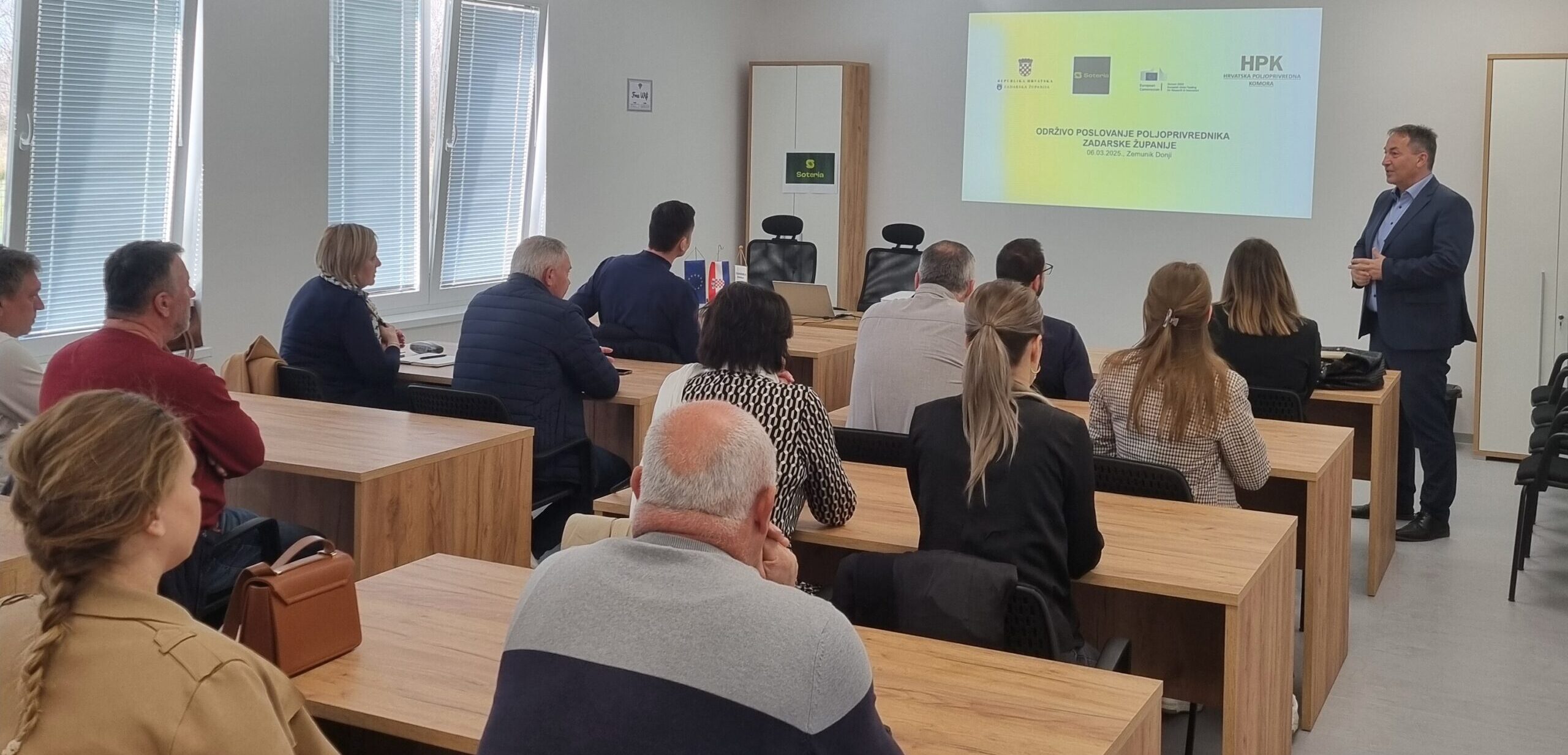
On March 6, 2025, SOTERIA’s associated partner Zadar County in Croatia hosted regional Climate Resilience Dialogue together with Croatian Chamber of Agriculture at the newly opened Agricultural and Educational Center of Zadar County in Zemunik Donji. The CRD focused to present the results of the SOTERIA project to farmers and to point out possible solutions for ensuring agricultural production that are adapted to climate change.
Stakeholders
Approximately 25 stakeholders participated in the CRD, including the Department for Agriculture, Fisheries and EU funds of Zadar County, Croatia Osiguranje (associated partner in the project), Croatian Chamber of Agriculture, Vereinigte Hagel VH insurance, AGRRA- Zadar County Rural Development Agency, University of Zadar, Local action groups LAG Mareta and LAG Laura. Additional attendees included local stakeholders: OPG Šimunov, OPG Čavlin, OPG Marino Jurjević, OPG Lukić Bojana, OPG Neven Jurjević and representatives of cooperatives such as Agricultural Service Cooperative Krupa, AGRO-LIŠANE Cooperative for agriculture and Association of vine growers and vine production “NADIN”.
Main topics of discussion
After the introduction of Mr. Daniel Segarić, the head of the Department for Agriculture, Fisheries and EU funds of Zadar County, to the regional CRD in Zadar, the dialogues covered three topics:
- – informing farmers about agricultural production insurance contracting models in order to reduce economic losses caused by adverse climatic conditions, and for the purpose of preserving their crops.
- – changes in the Strategic plan of the Common Agricultural Policy 2023-2027 in the coming period.
- – opportunities in agriculture through innovations.
Mrs. Tajana Radić from Croatian Chamber of Agriculture had presentations about above mentioned topics involving stakeholders into discussions.
1. Agricultural production insurance
SOTERIA project is funded by the European Union, dedicated to advancing insurance solutions for climate change adaptation across diverse European regions and communities. Given that farmers are losing income due to climate change, SOTERIA project seeks to see why there is a lack of interest on the part of insurance companies to create new insurance models, given that the climate is changing and agriculture has become unpredictable. On the other hand, each region has its own specificities and there is serious fear and resistance among farmers to insure their production and livestock under the current dominant insurance models, which very often do not cover damages, which is why farmers very often give up production.
Croatian Chamber of Agriculture in collaboration with SOTERIA partners, collected around 1000 opinions of farmers through a questionnaire. The survey results show that the majority of agricultural farms (81%) in Zadar County are smaller farms with an area of up to 20 ha. The main threats related to climate disasters were detected by processing the questionnaire, and in the area of Zadar County drought and heat waves are main threats. Of the total number of respondents, 76% do not insure their plantations.
The majority of agricultural farms in Zadar County have an agricultural area of around 6000 farms, but most farmers do not have crop insurance. The most common reasons for purchasing an insurance policy in agriculture are that the farmer has already experienced some major loss in his production and because they realized that this way they could protect their business. The main reasons why farmers do not take an insurance policy are: insurance policies are too expensive and insurance policies are not adapted to their needs.
Detected problems
Livestock farmers from the Zadar County area pointed out that one of the biggest problems are wolves and the damage caused by wolf attacks on livestock and properties. Numerous livestock farmers are suffering from these increasingly frequent attacks and the lack of solutions, as well as the inability to adequately secure their livestock they sell them because they cannot defend them from the wolves. Insurance premium is also very low for wolf attacks. Mrs. Radić mentioned that Croatian Chamber of Agriculture has two representatives in the ‘Wild Animals committee’, which is actively working within the Ministry of Environmental Protection of the Republic of Croatia and is actively advocating for this problem to be solved. We are aware of the fact that wolf damage creates major problems for farmers and no insurance covers this loss. Croatian Chamber of Agriculture are trying to find ways to mitigate these damages and ensure the viability of agriculture in these areas.
One of the Zadar county’s local cooperatives, AGRO-LIŠANE Cooperative for agriculture, that cultivates vegetables, melons and watermelons, root and tuberous vegetables (total production on 216 ha), has not yet insured its production because they have not had any serious problems so far. For them, the greatest potential risk is spring frost and hail, and they emphasize that they would be insured if the damage coverage ratios were increased, because the current insurance is not very generous.
Conclusions
Farmers are convinced that they would insure their crops and livestock more if insurance companies would put on the market different insurance models more quickly, which follow the increasingly strong climate changes, and they should also have policies for individual regions that have their own specific production problems.
Changes in the Strategic Plan of the Common Agricultural Policy of the Republic of Croatia (2023–2027)
The possibilities of existing measures from the Strategic Plan of the Common Agricultural Policy of the Republic of Croatia (2023–2027) that finance the risks of agricultural production are presented, and these measures are:
- – Measure 17.1.1. Insurance of crops, animals and plants
- – Measure 76.01. Insurance of agricultural production
- – Measure 73.02. Investments in the renewal of agricultural potential
- – Mutual Funds
Measure 17.1.1. Insurance of crops, animals and plants
Within the Rural Development Programme of the Republic of Croatia for the period 2014-2020, through the type of operation 17.1.1. “Insurance of crops, animals and plants”, support was awarded for co-financing the insurance premium (in the amount of 70%) for insurance policies covering losses exceeding 20% of the average annual agricultural production for the following risks: adverse climatic conditions (hail, frost, fire, drought, flood, etc.) and animal diseases.
Measure 76.01. Insurance of agricultural production
Mrs. Tajana explained the intervention 76.01. Insurance of agricultural production. Damages resulting from natural disasters, animal diseases, plant diseases or environmental pollution have a significant impact on farmers’ incomes. The intervention allows for the allocation of support for contracting agricultural production insurance so that farmers can more easily overcome disruptions in the production cycle due to climatic disasters or animal diseases, which are risks for which insurance can be contracted in the territory of the Republic of Croatia.
Measure 73.02. Investments in the renewal of agricultural potential
Measure 73.02. Investments – Restoration of agricultural potential aims to restore agricultural potential damaged by natural disasters and catastrophic events and thus ensure the sustainability of agricultural production and a source of income for the population of rural areas, thereby preventing the decline of agricultural farms, emigration from rural areas and enabling the continuation of agricultural activities.
The workshop participants were engaged by the discussion of the proposed changes to the Strategic Plan for the Common Agricultural Policy of the Republic of Croatia (2023-2027), particularly the establishment of Mutual Funds aimed at developing new support mechanisms to more effectively address and finance agricultural damages. While we presented the conditions for these mutual funds and sought participants’ input on potential improvements, interest in the topic was limited. Instead, participants expressed a greater concern for practical solutions to reduce wolf attacks on their livestock and emphasized the need for adequate insurance coverage for such incidents, as the current insurance policies do not sufficiently address this issue.
Proposal for the Mutual fund:
- 1. Producer organizations/agricultural cooperatives/farmers’ associations
- – be accredited by the competent ministry in accordance with the provisions of national legislation for a maximum of 3 years
- – must adopt a statute or legal act establishing the rules and regulations governing the mutual fund in accordance with the provisions of national legislation (if they already have a statute, they must adapt it to the provisions relating to the mutual fund before applying for accreditation)
- – must follow a transparent policy regarding payments and disbursements from the fund
- – must have an initial share capital
- – must keep the accounting and assets of the mutual fund separate from other PO/PZ activities
- – must ensure clear rules on the allocation of responsibility for possible debts incurred
- – define sanctions in case of negligence by farmers.
Eligible costs under this intervention refer to the administrative costs of establishing mutual funds, which may include, among other things, fund management costs, staff costs, overhead costs and other administrative costs spread over a maximum of three years (according to the descending principle that we will determine in the Rulebook). The intensity of support for the administrative costs of establishing mutual funds is up to 70% of the amount of eligible costs.
- 2. Beneficiaries – members of producer organizations/agricultural cooperatives/farmers’ associations
Requirement for Mutual Fund Users:
- – must be an active farmer
- – must be a beneficiary of direct payments in a given year
- – must be a member of the farmers’ association that established the mutual fund
- – must pay the agreed amount of contribution to the mutual fund.
The basic eligibility conditions for the payment of compensation from the mutual fund will be prescribed by a legal act of the association of farmers that manages the mutual fund. The intensity of support for the financial contribution to the mutual fund from the EAFRD is up to 20% of the total annual contribution of the members of the mutual fund and other legally acquired assets of the mutual fund, but the total contribution from the funds and state support must not exceed 70% of the total eligible costs.
All of the above interventions aim to help farmers and mitigate disasters caused by various agricultural disasters.
GO BACK