



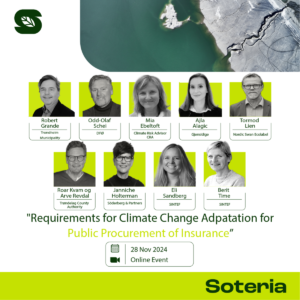
On 28th November, we convened the second Thematic Meeting hosted by Network Climate Change Adaptation Trøndelag. Our hosts Eli Sandberg, Sandra Lilledal, Ajla Alagic, Mia Ebeltoft, and Berit Time led the discussion on “Requirements for climate change adaptation for public procurement of insurance.” We were joined by an impressive lineup of speakers, including Odd-Olaf Schei (DFØ), Tormod Lien (Nordic Swan Ecolabel), Robert Grande (Trondheim Municipality), Roar Kvam og Arve Revdal (Trøndelag County Authority), and Janniche Holterman (Söderberg & Partners).
The discussion highlighted the vital role of municipalities in integrating climate adaptation into procurement strategies, emphasizing practical solutions to mitigate climate risks effectively in Norway’s unique context.
Key insights from the webinar included:
📌 Climate change adaptation has a modest role in public procurement compared to a reduction of greenhouse gas emissions
📌 Requirements for emission reductions and energy efficiency can have transfer value to climate change adaptation. This is an area that needs to be developed further and where SOTERIA can contribute
📌 There is a development in the direction of more focus on needs and end users in the planning phase and a focus on damage and loss prevention. The requirements set vary greatly between municipalities. Requirements for risk analysis for the building stock is a criterion in Trøndelag County Authority
The webinar served as a collaborative space for exchanging ideas and practical solutions, emphasizing the role of municipalities in advancing climate adaptation through informed procurement strategies.
By exploring the integration of insurance products and procurement processes tailored to climate challenges, participants gained actionable insights to drive resilience at the local level.
This session highlighted Norway’s leadership in fostering innovative approaches to public insurance procurement. It underscored the importance of collaboration between policymakers, insurers, and municipal authorities in shaping adaptive solutions for a changing climate.